Our first research article based on the encoded corpus was published last month in Slavic Review. It came out in the first special Digital Humanities cluster in the journal. This means we’re officially the first scholars to have published a piece of code in the main journal for Slavic, East European and Eurasian Studies! This was not on either of our career bingo cards! The article focuses on questions of liminality in The Double and asks what computational text analysis might reveal about the structure and form of the novella. It has everything: XML code, visualization, Dostoevsky’s musings on the fantastic, a deep dive into the neologistic verb stushevat’sia, and fish pies!
The article is available free and open access, thanks to a publishing agreement between the University of British Columbia and Cambridge University Press. You can read it here!
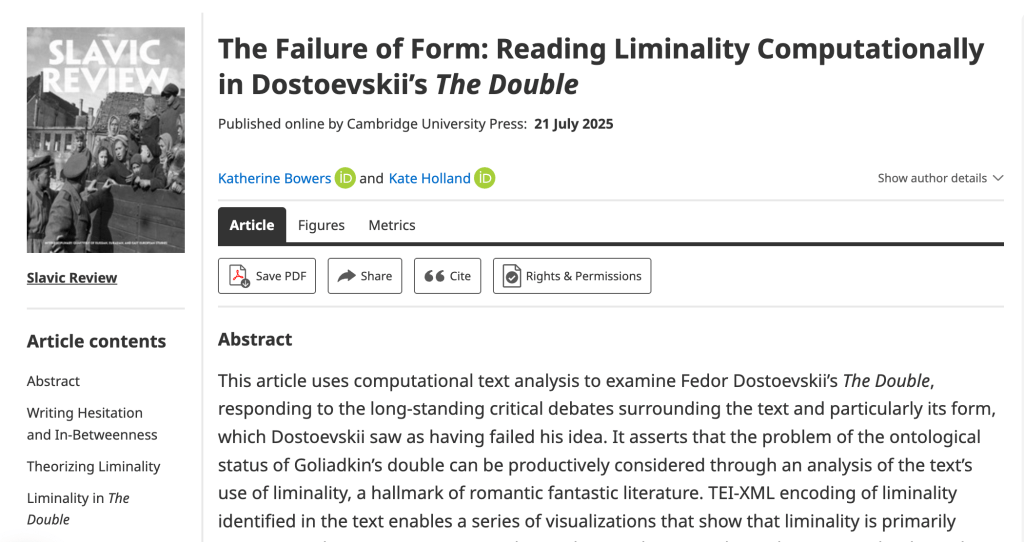
It went through triple blind peer review, and improved considerably thanks to the reviewers’ suggestions and advice, as well as the feedback from friends and colleagues. We feel that it’s important to repeat our acknowledgment note from the article here too: This article is the result not only of our mutual collaboration, but also of our collaboration with others. We are particularly grateful to the Digital Dostoevsky team members, especially Braxton Boyer and Elena Vasileva, with whom we had many discussions about the way that we tag and interpret The Double. Veronika Sizova’s careful and thorough reading of our XML file and corresponding plain text corpus file has helped us prepare our text and its related data for publication. This article would not have been possible without them. The Digital Dostoevsky project is supported by an Insight Grant from the Social Sciences and Humanities Research Council of Canada (SSHRC). The project is also supported by the University of British Columbia (UBC) Library’s Research Commons. Digital Scholarship Librarian Eka Grgurić has worked with the team since the project’s inception in 2020. Her advice and support have been invaluable. We also thank Data Librarian Jeremy Buhler for his help with Tableau and refining our data visualizations. We have appreciated Quinn Dombrowski’s helpful advice as we have worked on this research. Our work has been significantly improved through the thoughtful feedback of readers Connor Doak, Tatiana Filimonova, and Anouk Lang in its early stages. We thank them and the three anonymous readers from Slavic Review, who helped us focus our argument. We are grateful to the audiences that have heard or read this work in progress: in particular, our 2023 Association for Slavic, East European, and Eurasian Studies (ASEEES) panel audience, especially Andy Janco, Robin Feuer Miller, Eric Naiman, Jillian Porter, and Amy Ronner; and the members of the Historical Poetics Reading Group, especially Ilya Kliger, Michael Kunichika, Boris Maslov, Jessica Merrill, and Victoria Somoff. Their constructive suggestions, questions, and discussion helped to shape the final version of the article.
 Digital Dostoevsky
Pingback: Introducing Digital Dostoevsky | Digital Dostoevsky