We recently dipped our toes into the wonderful world of topic modeling, a method that takes a mathematical approach to assess the probability of words occurring when an author is discussing a given topic, parsing all the words in the corpus. Topic modeling looks for broader patterns in how words are distributed across the corpus to determine the probability of them appearing together. Another way of putting this is to imagine that Dostoevsky’s writing can be understood through 10 different vocabulary patterns (the topics). Looking at all the words he uses and the patterns in which they appear, what might those 10 groupings be? As Jacob Murel puts it in his topic modeling tutorial, “In this way, topic models essentially attempt to reverse engineer the discourses (that is, topics) that produced the documents in question.” Our model was set to return the 10 words that have that greatest chance of appearing when Dostoevsky writes about each topic.
We were interested in looking at Dostoevsky’s journalism and fiction to better understand and compare how concepts appear across these two bodies of work. The journalism is often characterized as right-wing and ranty, while the fiction is frequently seen as exempt from these tendencies. We were hoping that topic modeling might be able to signal that these two corpora share more than is typically identified by scholars, in other words, whether the topics and words might recur across both corpora.
Once we got the hang of the method, we realized that topic modeling was a bit different from what we had first thought. One thing we discovered was that while some topics could be easily identified, such as a sentimentalist topic, a Petersburg topic, and one about Siberia, we always had one topic which we simply could not define, as the words, while very frequently occurring, became almost meaningless because of their use across so many different topics. For instance the word человек (person) appeared in 7 of the top ten topics in our combined corpus.
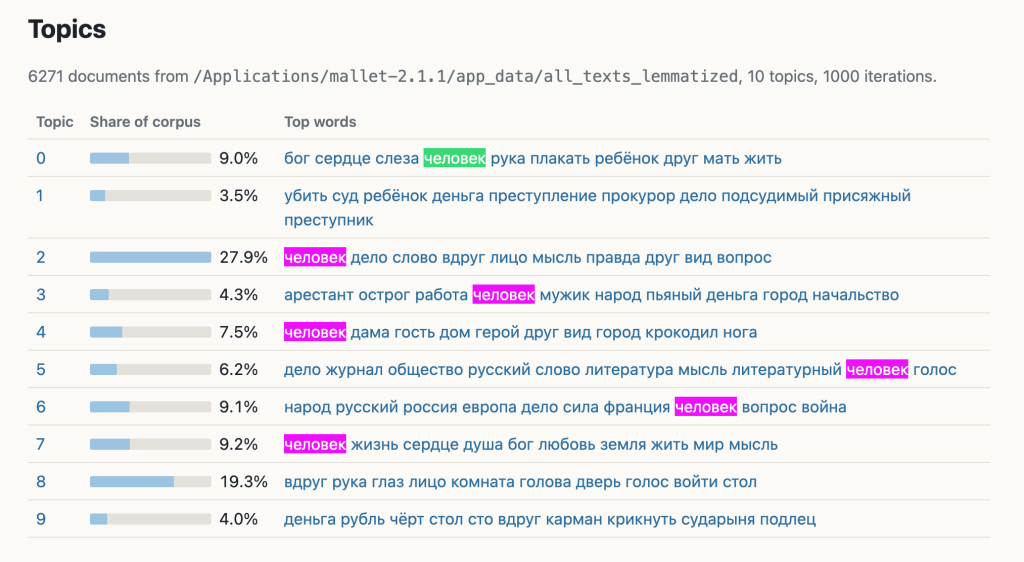
Other examples that we found in many different topics were the words вдруг (suddenly), народ (the people), and бог (God). These constituted a kind of Dostoevskian verbal soup which seemed like it should have been meaningful, but actually diluted our results. The idea that Dostoevsky has a kind of verbal, conceptual filter over his writing made a lot of sense to us, even if it seemed wildly counterintuitive to remove God, man, and the people from our Dostoevsky corpus. We soon realized that although we kept taking out words that recurred across topics, we were left each time with a Dostoevsky soup topic, and so had to consider the other nine most important topics in order to better understand our corpora. All the soup talk reminded us of Seinfeld’s soup nazi and the ensuing meme.
One discovery we made using this method was that identifiably nationalist topics occurred across not only the journalism but also the fiction, and when we combined the corpus we found that there were some shared topics with nationalist tendencies. We shared our findings at the North American Dostoevsky Society panel at ASEEES which was on Dostoevsky, Race and Empire. One argument we are now able to make, thanks to our results, is that the appearance of antisemitism in Dostoevsky’s writing begins much earlier than we expected and is embedded in a whole network of nationalist ideas developed in his journalism and fiction upon his return from Siberia. Often scholars argue that the pochvennost’ or ideology of the soil that Dostoevsky developed in the early 1860s was a much more conciliatory belief system than his later messianic utopian nationalism, but our findings showed that in fact the later beliefs have their roots in these earlier ideas. This work will be part of a longer chapter in our Computational Dostoevsky book that uses distant reading methods to answer some of the classic questions of Dostoevsky Studies.