This fall, Kate and I have been doing more detailed network analysis work, building on our Demons forays into this method for our Buenos Aires paper. We have been focusing on analyzing The Idiot, but have now also done speech networks for all five of the major mature novels. We read a new book by Tara K. Menon, Speaking Parts, which focuses on the question of direct speech in the 19th-century British novel. Menon does some speech network visualizations, although her networks are built using a different method than ours as her corpus is not TEI-encoded. One of her chapters focuses on Middlemarch and the question of protagonicity, that is, the main character and their space within the novel.
This got us thinking about Dostoevsky’s novels and how the space that the protagonist occupies within the speech network changes over time, both within the novels, and across the corpus. For instance, we might think about how much Raskolnikov dominates and also shapes the structure of Crime and Punishment versus the ways in which Nastasya Filippovna seems to disappear in The Idiot after Part I.
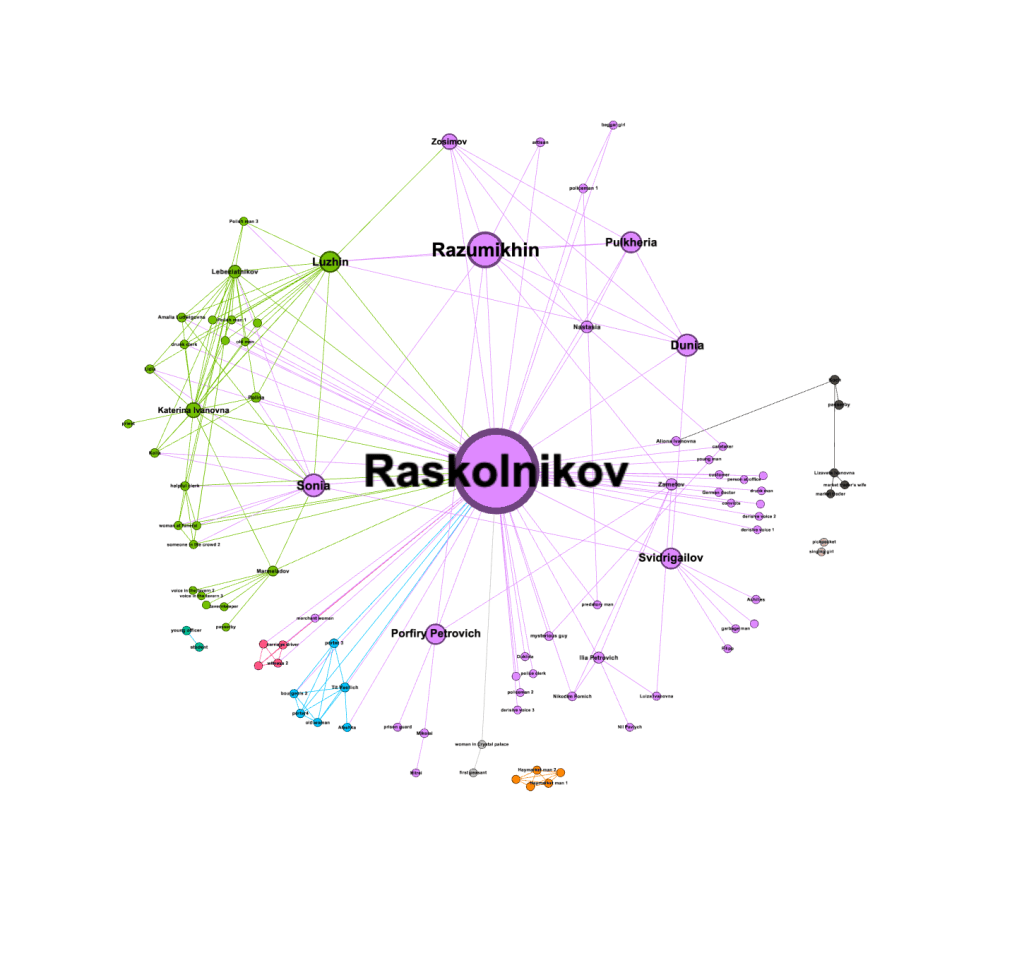
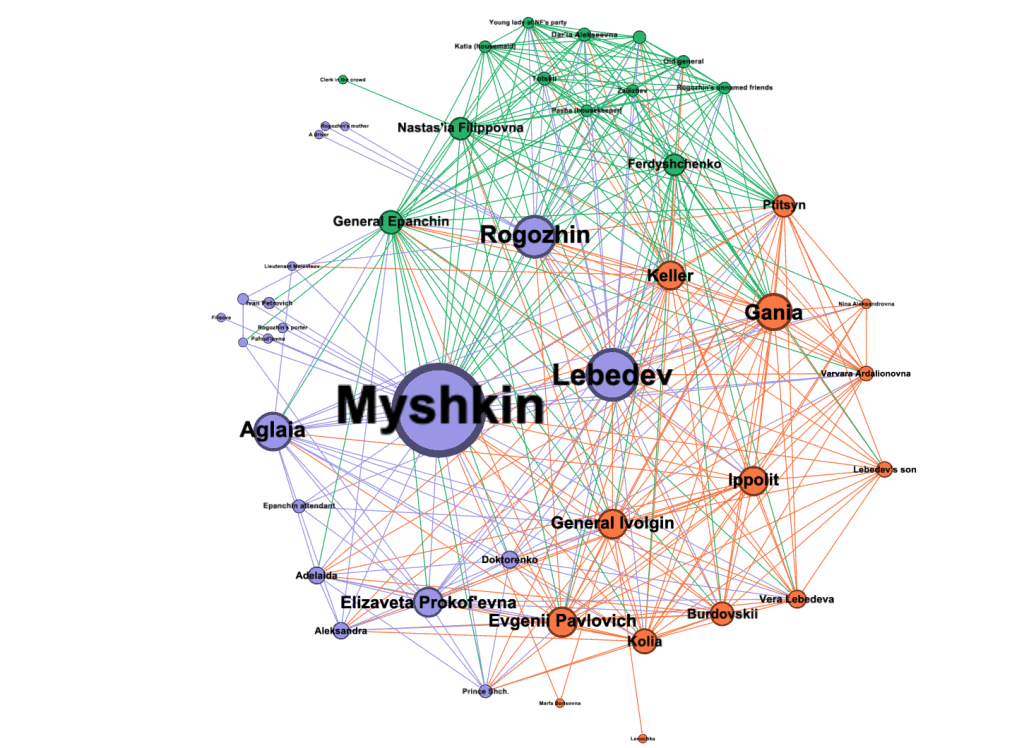
While we have been thinking about networks, Braxton has been working to standardize our encoded corpus. Thanks to Braxton’s work, we now have a more efficient pipeline to provide cleaned speech data from our corpus in the form of csv files we can import into Gephi and/or modify to examine individual scenes. The visualizations that used to take us several weeks to do as we had to continually go back and clean data now can be done in a day or two. This means that we can do some thought experiments that we’ve been wondering about for a while. One of these is: what happens to the novel’s structure if we remove the hero from the speech network. First of all, we decided to take a look at the Crime and Punishment network without Raskolnikov.
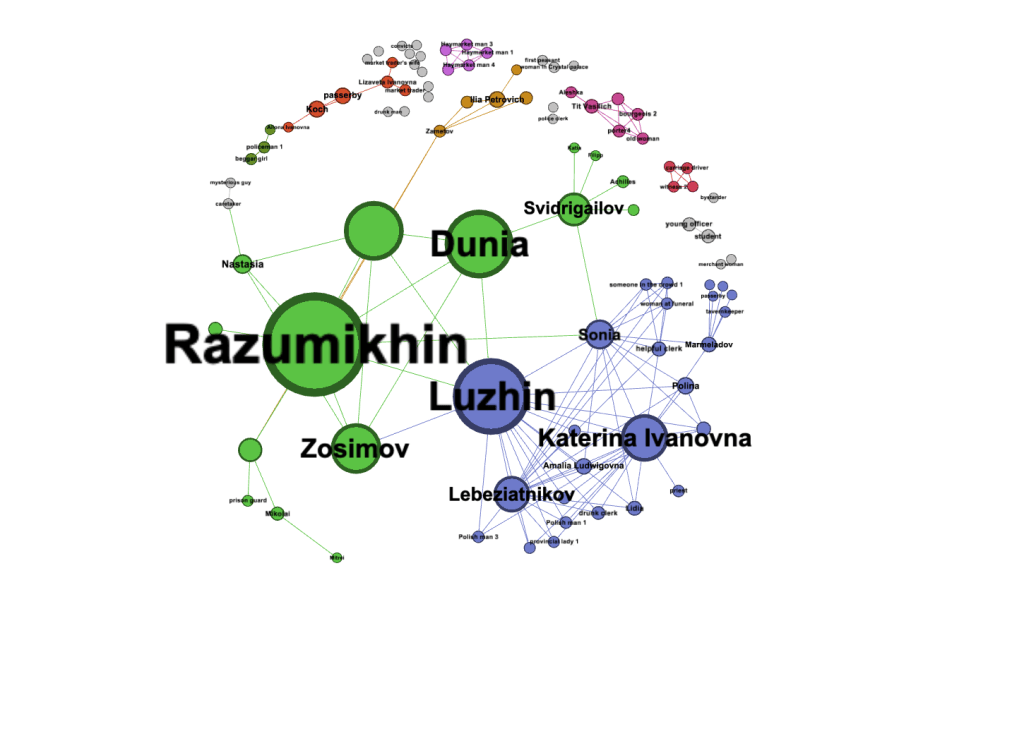
Whereas the original speech network visualization of Crime and Punishment was clearly ordered around Raskolnikov, with the other characters all radiating out in a circle formation, without him, the network begins to look like a bit like an ammonite, swirling around from the beggar girl and mysterious guy to Razumikhin, who takes up the most prominent role. Unsurprisingly, there are lots of disconnected groups of characters; these are the ones that swirl across the top of the visualization. Like a fossil, the network is formed around a space defined by the absence of something.
In The Brothers Karamazov we can extend the thought experiment still further by removing each of the brothers in turn. In these images, first we have the full novel, then we remove Alyosha, then Alyosha and Mitya, and finally Ivan as well.
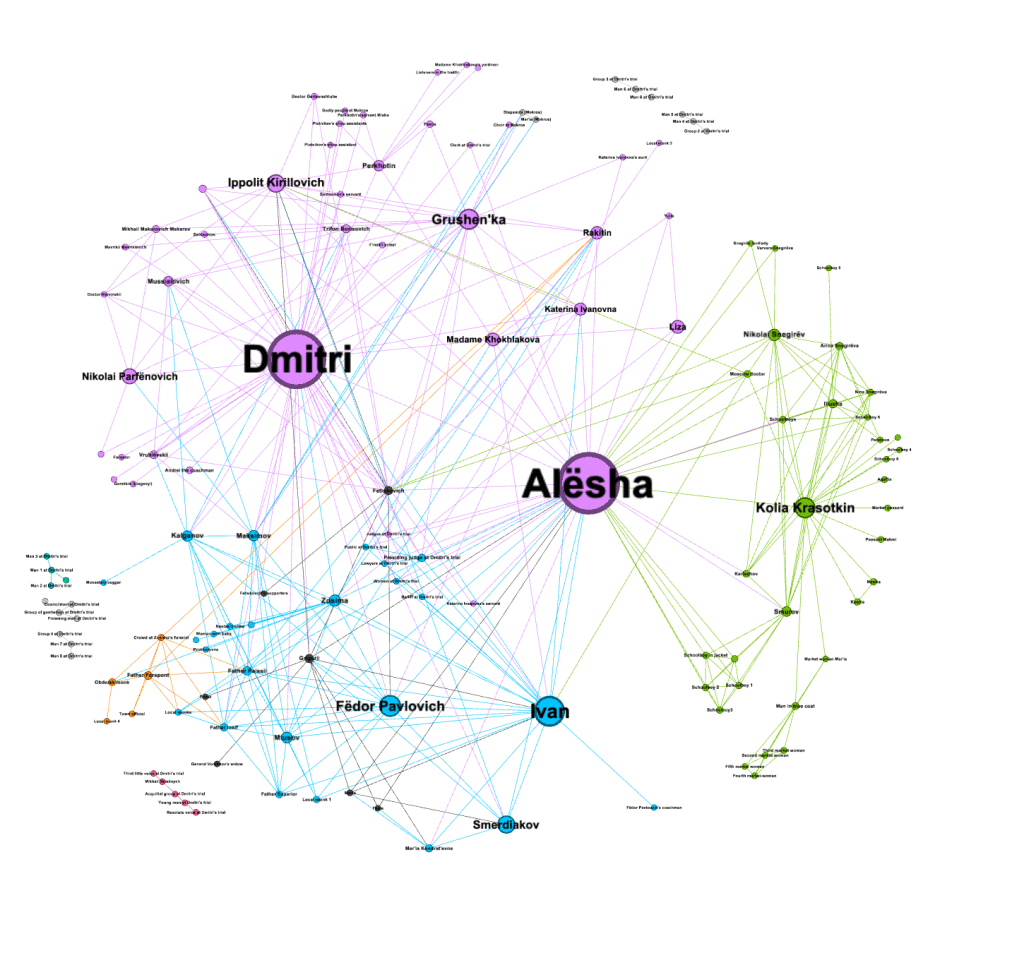
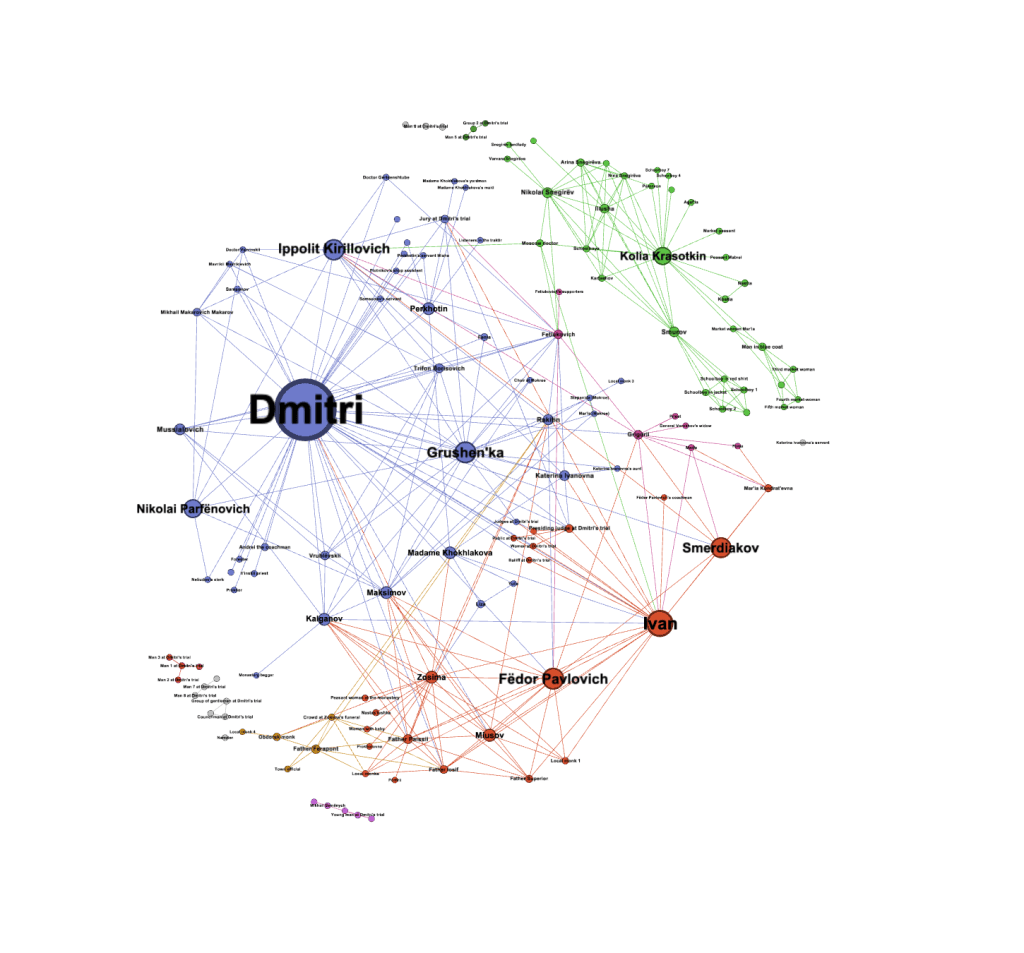
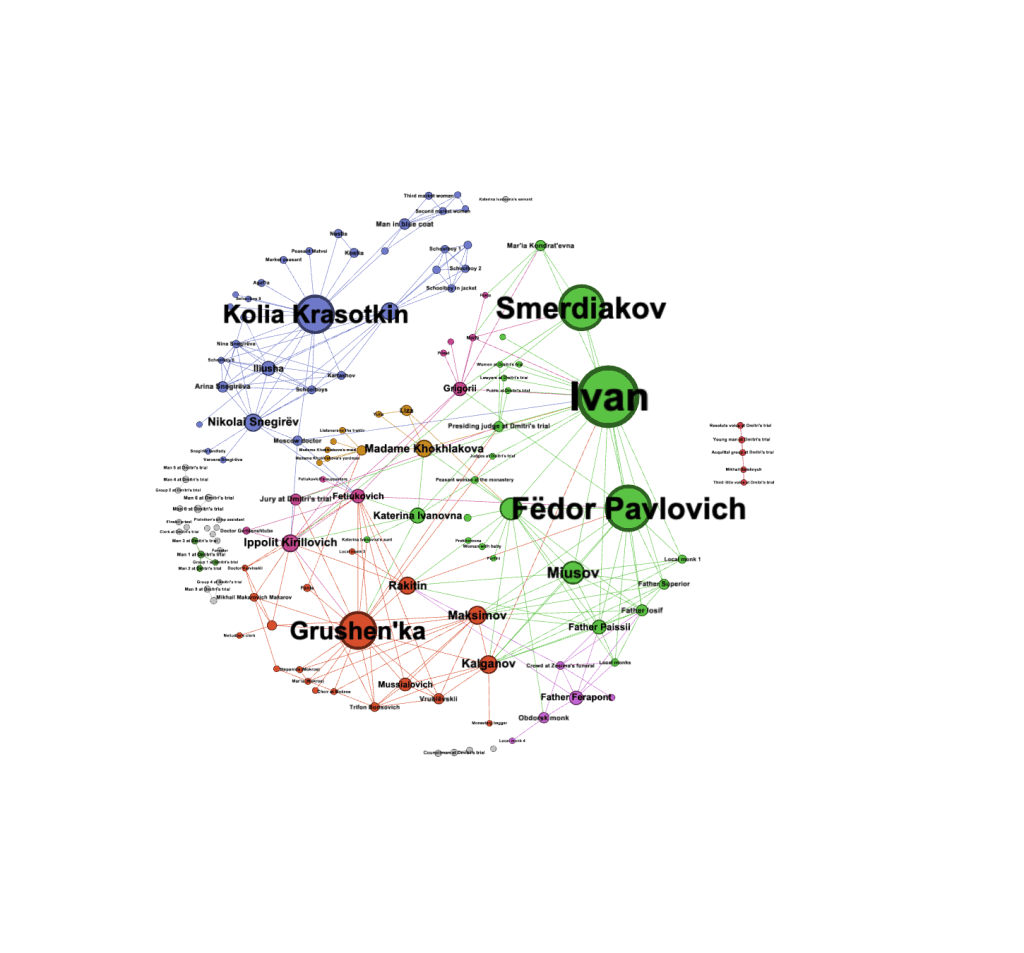
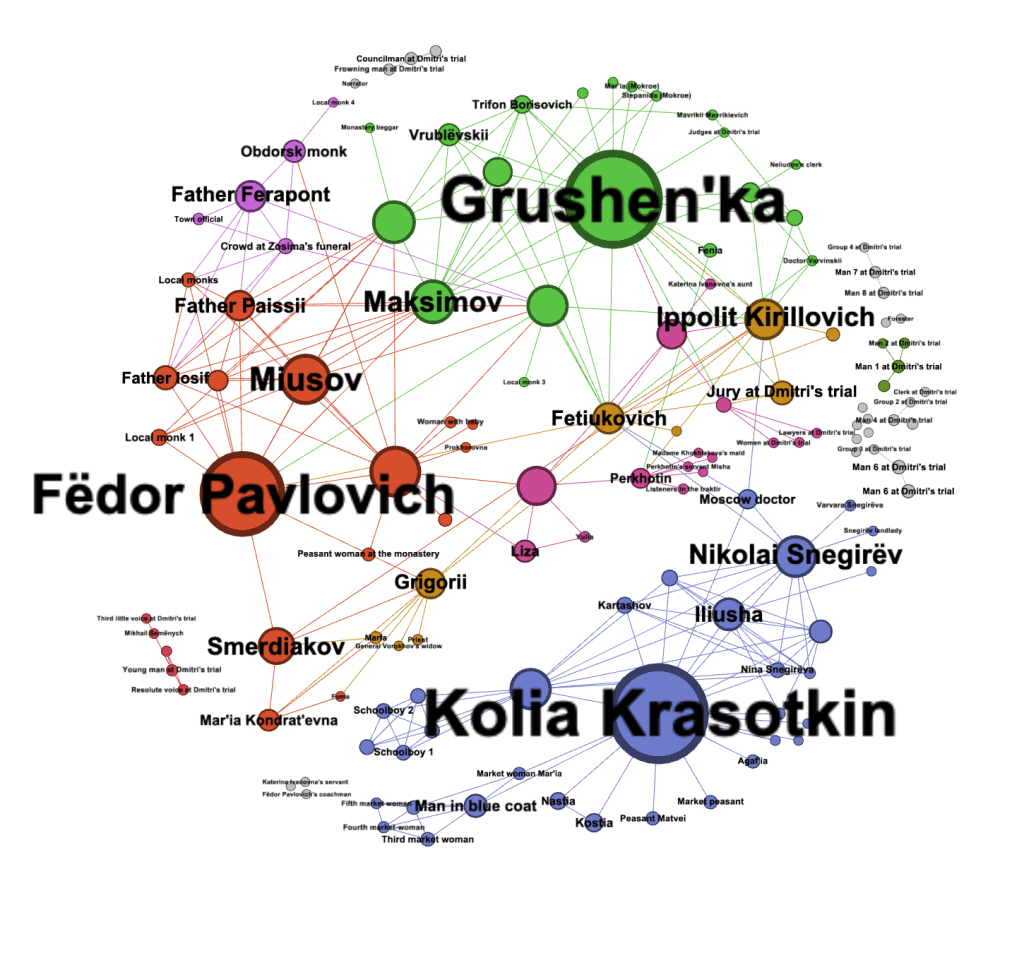
When Alyosha is removed, Dmitry becomes the most prominent character, then without Alyosha or Dmitry, Ivan assumes that role, although he has close competition for it from other characters (Kolya Krasotkin, Fyodor Pavlovich, Smerdiakov, and Grushen’ka). When we remove all three brothers, Grushen’ka becomes the main protagonist, although we can see that the novel is again fossilized, taking on a tripartite structure with Grushen’ka balanced by Fyodor Pavlovich and Kolya Krasotkin. Intriguingly, The Brothers Karamazov without the brothers Karamazov holds its structure.
This imagery of fossils is intriguing to us not just because of Raskolnikov’s fever dreams in Siberia, but also because we can clearly see through these visualizations how the structure of the novel contains the impression of the living organism (the character) even after it has been removed. The networks linked through the character remain as the novel’s structure is so tightly linked, so we can still see the impression of the three brothers in the network.

